Origins and Etymology of Lilith
The origins and history behind Lilith the demoness, and the etymology of the name, including transliterations, transcriptions and more.
This is a living document - subject to changes, updates, additions and redaction as I learn, understand and proffer new knowledge. If you have input, email me at [email protected], or drop a comment on this post! Update 07/06/2026: Thank you, kitty cat, for your inputs, especially around the Greek histories and Hebrew translations.
Lilith
We all know of the name Lilith. I know that I am biased, but I am confident that even you, dear reader, are aware of the name too.
Lilith has many histories, and the transliterary collections of meaning, origin and purpose. In almost every culture and religion, Lilith (or the relevant translation of the name) represents evil. Some form of demon, evil spirit or lord of the underworld - almost always in the form or appearance of a young adult woman. In many origin stories, she also manifests the concept of the Succubus - a form of demon or spirit that uses sex and pleasure to do… something evil. Results of the Succubus vary between religions and origins, but a common theme is that they steal some or all of the soul of their victims through adultery and/or sex.
My purpose here is to attempt to ‘unwind’ the looped and knotted thread that consists of Lilith’s origin. To map all her histories, her names, and her origins, and to lay them out plainly.
My purpose here is NOT to tell you what to believe, or what to think of Lilith. I do not intend to lead you down a path, or to tell you how you are wrong and my opinion is correct. Rather, I intend to lay out all the information as I can find it, in the form of a living document, and let you pick and choose how you see to interpret the idea of Lilith.
Cultures and Religions
The earliest recorded reference to Lilith as an entity, was in an ancient Sumerian tale “Gilgamesh and the Huluppu-tree” - potentially another name to the Ancient Sumerian Epic “Gilgamesh, Enkidu and the Underworld”, or potentially just one part of the epic. In this tale, Lilith is a dark demon who takes up residence in the trunk of the great Huluppu-tree (likely a Willow, by modern understanding) planted by Inanna (to the Sumerians, known as Ishtar to the Akkadians) in her garden in Uruk (birthplace of Gilgamesh, now understood as having existed geographically in Warka, Iraq). Inanna had rescued the tree from the river Euphrates after it was swept off the shore by the terrible tides and storms caused by Nether-lord Enki setting sail for the Underworld. Inanna had tended to the tree in her garden, intending to make from its a wood a bed and a throne, but before she could harvest the tree, some unwanted guests claimed it as home.
In one understanding of “Gilgamesh and the Huluppu-tree” - the ‘Zu-bird’ had set up a nest in its branches, a dragon had laid a nest at the base of the tree, and the demoness Lilith had built her house in the trunk.
In another understanding, associated with the name “Gilgamesh, Enkidu and the Underworld” [12], the mythical Storm Bird ‘Anzu’ had built a nest in the branches, a serpent at its roots, and Lilith in the midst.
Either way, the earliest known reference to the modern name Lilith is from the Mesopotamian region, originating over 4000 years ago. Lilith’s origin is squarely set in what is known as the cradle of life - her name and image a key component of the human condition for as long as collected society has existed. Depending on how you look, Lilith as an idea predates Judaism - which historically (and without religious inference) originated out of Canaanite (A.K.A. Pheonician, if you ask the Greeks) belief systems around 1200-1000 BCE. Lilith as an idea was prominent in Judaism, so much so that in the book of Isaiah, first Isaiah, Lilith is mentioned curtly by name (in Isaiah 34:14) but with no reference to who or what she is. It seemed that Isaiah saw no need to expand on what the ‘Lilith’ was, so prevalent was her name.
I trace her origin squarely to the Sumerian civilization, though I can optimistically conclude that she existed long before the Sumerians were writing about her - we just don’t have the written record. It is completely reasonable within my mind that an early civilization of humans, cursed with too much creativity and brain power, but not enough understanding of the world, would attribute things to the evil spirits of the world. Historical amulets, incantation bowls, reliefs, and scriptures often relate Lilith to birth, The Alphabet of Ben Sira going so far as to say that Lilith was cursed by Lord God such that for every day she does not return to Adam and the Garden, 100 of ‘her children’ would be killed. It is theorized that the story of Lilith was one used to explain high infant mortality and still-birth rates. I can reason that this concept existed well before documented in The Alphabet of Ben Sira, and likely well before the Sumerians wrote of her as the evil wind spirit in the Huluppu-Tree.
Lilith existed fairly extensively throughout the evolution of written Judaism, and often was practiced in house-hold prayer and warding (that is to say, to ward her off.) The Alphabet of Ben Sira writes of her as striking a deal with the divine: Lilith swears in the name of God that she will not harm any infant who wears in amulet bearing her name. This lends to her name being a household item, not out of worship, but out of warding.
Timeline
Source: The history of Lilith from the Biblical Archaeology Society [3]
- 2000 B.C.E: Sumerian Poem “Gilgamesh and the Huluppu-Tree” [1]
- 1800 B.C.E: Babylonian Clay Relief “Burney Relief / Queen of the Night” [2]
- Initially thought to be an impression of Lilith, later understood to be an impression of Inanna/Ishtar.
- 700 B.C.E: Assyrian/Phoenician amulet “Arslan Tash Amulet (AT1)” [4]
- 700 B.C.E: Hebrew/Jewish Bible - Book of Isaiah / First Isaiah “Isaiah 34:14” [5]
- Lilith is mentioned by name in traditional Hebrew form ‘Lilít’ with no additional description to her, supposedly taking her existence for common knowledge
- 300 B.C.E: Hebrew/Jewish Manuscripts “Dead Sea Scrolls / Qumran Caves Scrolls”: “Songs of the Sage” [6]
- 300 B.C.E: Greek Bible Translation “Septuagint” [14]
- The Septuagint translates both the reference to Lilith and the word for jackals or “wild beasts of the island” within the same verse into Greek as onokentauros, apparently assuming them to refer to the same creatures and omitting “wildcats/wild beasts of the desert.”
- 300 C.E: Latin Bible Translation “Vulgate” [13]
- Translated Isaiah 34:14 from “Lilith” to “Lamia” - relating Lilith to Greek folklore, of a creature impressed as both a Succubus and a devourer of infants.
- 400 C.E: Babylonian Jewish Text “The Babylonian Talmud” [7]
- 600 C.E: Jewish Incantation Bowls [8] [9]
- 700-1000 C.E: Hebrew/Jewish anonymous text “The Alphabet of Ben Sira” [10]
- First biblical text to refer to Lilith as the first wife to Adam. Prior to this point, there was no connection between Lilith, Adam, Eve, and The Garden of Eden.
- 1200 C.E: Jewish Kabbalah foundational text “The Zohar” [11]
It is important to note that no common renditions of the Christian Bible make reference to Lilith, instead transliterating her as a “Night dwelling demon” or “Screech Owl” - likely a close reference to her imagery in the Burney Relief (which is now believed to actually be a rendition of Inanna, the god of Love and War, which raises even more questions!)
Historically, we can see a close relation between Lilith and the cradle of life - her story beginning somewhere in Mesopotamia / Sumer, and surviving through to the birth and foundation of the Jewish religion through to most modern religions that inherit or split off from Judaism.
The Name
If we go as far back as we can, to the time of the Sumerians and the Akkadians, the concept of Lilith was more broadly explored across multiple terms - potentially even idealised as not a single entity, but a family or group of entities.
- Lilû (Male-form wind spirit OR simply wind ghost/spirit)
- Lilītu (Female-form wind spirit / Night Spirit)
- Ardat-lilî (Type of female demon, described mostly as Succubus-like, “Maid of the Night”)
These names themselves are interesting - ‘lil’ being a base word for all of these names, and generally being related to “winds, ghosts or demons”. The later Hebrew word ‘lilit’, appearing in Isaiah 34:14 also shares this base, and is thought to refer to the ‘Night Bird’ in modern contexts. Additionally, in Akkadian, ‘lilâtu’ corresponds to the concept of night. As a result, Lilith and all her related concepts exist in a category of their own, often referred to as líl-demons (though finding anything useful under this name is hard, considering the 2024 hit rap song “Lil Demon” by Future tends to come up first when looking for it).
Interestingly enough, early renditions of Lilith exist as a wind spirit, rather than more prominently a demoness/lord of hell. Demons as a whole were not well defined in the Mesopotamian beliefs - this was moreso a creation of the Judaist inference. Lilith was known to fly - be it on wind or wings. As far back as the Arslan Tash amulet denotes her as having wings of the Underworld (what we might call demon wings - noting that the Sumerians and Akkadians did not tend towards the term ‘demon’), while the Burney Relief envisages her as having the wings of a bird (close relation to Owls, as they exist in their natural form in the same relief). That is all to say - Lilith being known to fly on some form of wing, lends well to her being a spirit of the wind. Her early origin stories with Gilgamesh also place her in context with the Storm Bird, a Dragon, and a Serpent. It could be argued that some similarity exists between all of these concepts. One may note that some understandings of the tale have the trio appear as “Dragon, Lilith, Zu Bird” and some have them appear as “Serpent, Lilith, Storm Bird” - this may point towards some early relation of Lilith to the Dragon. Lilith as the evil wind spirit is prevalent in both versions of the tale, but only one features a Dragon.
Back to names, around this time of history, the written language would have been a form of Sumero-Akkadian Cuneiform, which has some fairly well documented syllabary matrices, notably:
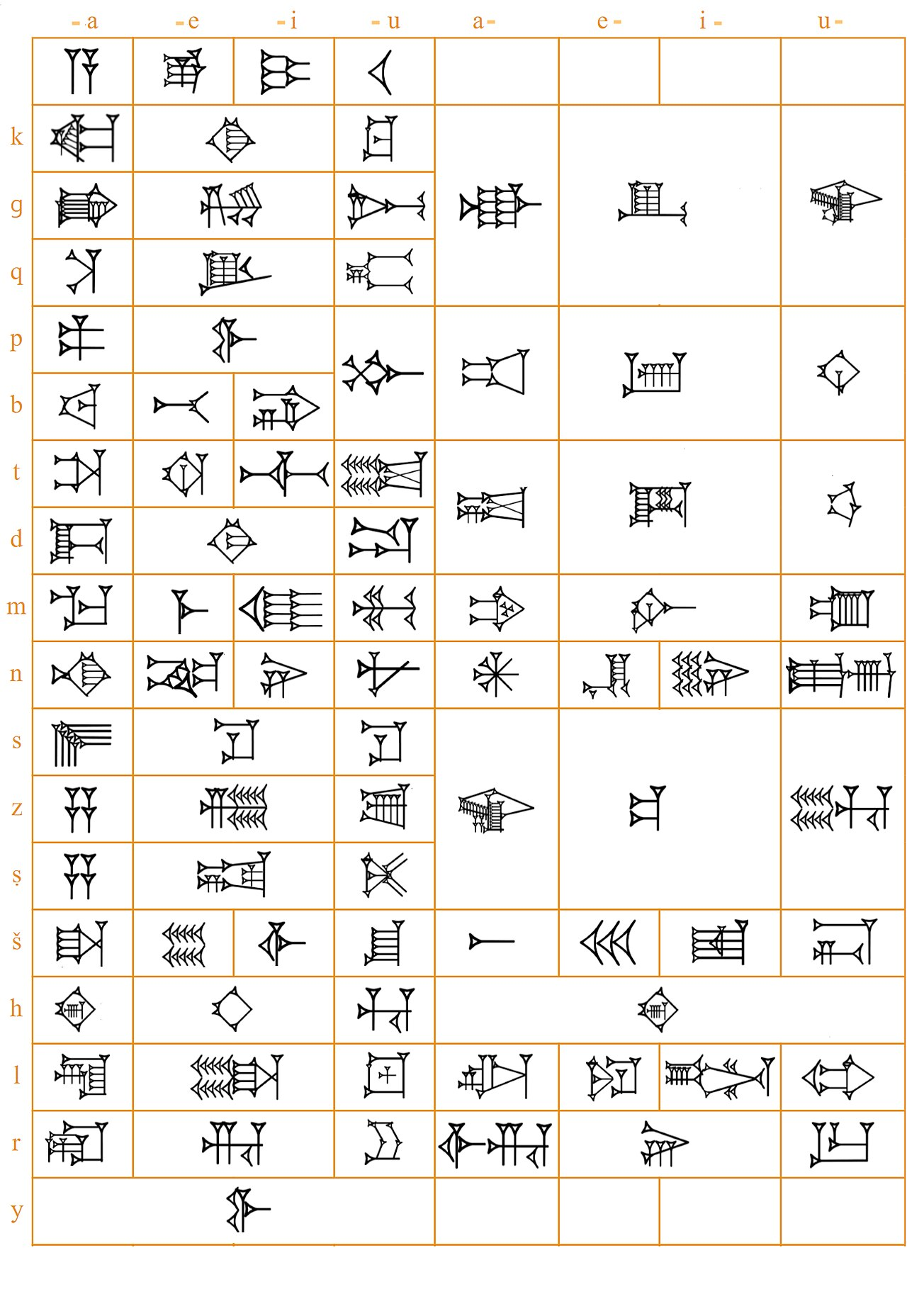
Additionally, there were many symbols of import - but I will only mention the relevant Dingir here:
Dingir ⟨𒀭⟩, usually transliterated DIĜIR, is a Sumerian word for ‘god’ or ‘goddess’. Its cuneiform sign is most commonly employed as the determinative for religious names and related concepts, in which case it is not pronounced […] (Source)
It should be noted that the symbol in pure Sumerian was originally an ideogram for the Sumerian word ‘an’ meaning ‘sky’ or ‘heaven’.
References to Sumerian/Akkadian gods or spirits would often come prefaced with this symbol. That is to say, using the syllabary above, and the Dingir, we can conclude that Lilith would have likely been written syllabically as:
- Lilītu / 𒀭𒇷𒇷𒌅
𒀭 = God/Goddess/Spirit/Sky/Heaven
𒇷 = Syllable for Li / Le
𒌅 = Syllable for Tu
Cuneiform also has symbols and iconography for particular nouns and proper nouns, depending on their usage and import. Another common name for Lilītu was “Night Spirit”, which might be written as:
- Lilītu, “Night Spirit”, “a wandering demon that preys on pregnant women and children” / 𒊩𒆤𒇲
Where “𒆤𒇲” translates from Sumerian to “Lilû” as “a demon”, and “𒊩” translates from Sumerian as woman.
A more complete list of the cuneiform signs can be found here, or the Unicode symbols here.
More information on the Akkadian language can be found here.
This leads us on to the Ardat-lilî - the class of Lilith-like spirits and succubi - or perhaps an alternate rendition to her concept. In some cases, Ardat-lilî were called “Maid of the Night”, which translates as:
- Ardat-lilî, “Maid of the Night” / 𒆠𒂖𒆤𒇲
Where 𒆠𒂖𒆤𒇲 translates to Kisikillilla, “Succubus demon”.
In Hebrew, Lilith is rooted from the Semitic term for “night”, and functions as a feminine adjective or noun for the ideas of Nocturnal/Night Monster/Lady of the Night. It is a loanword from Akkadian ‘lilītum (Lilû, Lilītu) / 𒊩𒆤𒇲’. It should be noted that by this point, the difference between Lilītu and Ardat-lilî is thoroughly lost, as now Hebrew is rooting the term from “Lady of the Night”, which was the term commonly used to describe Ardat-lilî.
While the concept of the name in Hebrew translates to Lilith, functionally it would have existed as ‘lilít’, without the ‘th’ sound we use today.
- lilít / לילית
It is functionally pronounced as ‘lilít’ and can also translate as a noun for: “An owl” or sometimes more specifically “tawny owl”.
ל = Approximate English transliteration for ‘l’ as in ‘learn’
י = Approximate English transliteration for ‘y’ as in ‘yes’ but also frequently used as a vowel marker, often to create an ‘ee’ or ‘eh’ sound.
ת = Tav symbol, Approximate English transliteration for ‘t’ as in ‘top’
I.e. the hebrew consonant soundings of ‘lilít’ are “lylyt”, when reading לילית right to left.
Notably - how we end up from ‘lilít’ to ‘Lilith’ is a combination of undefined translations and anglicized-Germanic translations. Notably, the Tav symbol can be translated multiple different ways, depending on who’s works you base your translational methodology on. In 1821, Moses Stuart’s grammar dictates that the Tav symbol written without the Daghesh lene (I.e. written as ת and not תּ) is to be aspirated, e.g. ת = th. But with the Daghesh lene, they do not have the apirate h: תּ= t. When translating from the Hebrew bible into the Germanic languages, לילית would get translated to “Lilith”, with the Germanic “th” being pronounced as “t”. A little kitty linked me to an incredibly helpful stackexchange post on this exact topic, which can be found here.
Some earliest references to Lilith in recent history, after the various translations of the bibles evolved her out in favour of local mythos (Screech Owl, Lamia, etc…), came in Germanic literature in the Romantic Period (1789 - 1832), where she was a character in Geothe’s 1808 work “Faust: The First Part of the Tragedy”. This script would have been written in Germanic, with the Hebrew ‘Lilít’ from the first Isaiah translated to ‘Lilith’.
Faust.
Wer ist denn das?
Mephistopheles.
Betrachte sie genau!
Lilith ist das.
Faust.
Wer?
In further translations of Faust to English, the Germanic was anglicized and simply kept as “Lilith”.
Faust.
Who, then, is that?
Mephistopheles.
Look at her well.
’Tis Lilith.
Faust.
Who?
Notes on Hebrew:
I will not pretend to know anything about Hebrew, beyond what I can glean from research. In saying that, Hebrew is a consonant-only script, read from right to left. There are some ways to interpret its characters under English consonant and syllabary sounds, which if you are interested more broadly in, can be found here and here.
Summary
Lilith comes in many forms through the languages of time:
It has roots in: Sumerian, Akkadian, Hebrew, and now English
- Lilith (Germanic: Lilit, English: Lilith)
- lilít / לילית
- Lilītu / 𒊩𒆤𒇲 / Syllabically 𒀭𒇷𒇷𒌅
- Ardat-lilî, “Maid of the Night” / 𒆠𒂖𒆤𒇲
The King James Bible translated Isaiah 34:14 to “Screech Owl” and not “Lilith”, which would have been some English form of Sckryche-Owle at once point.
The Greek translation of the Old Testament (and first Isaiah) (the Septuagint) translated “Lilith” as ∂νοκένταυρος / onokentauros - a mythical creature with the body and legs of a donkey, but the head, torso and arms of a human. In the context of the translation though, it could have also simply meant ‘jackals / wild beasts of the island’.
In the Latin Vulgate, St. Jerome translated the hebrew Lilith as Lamia - Greek folklore for a child-devouring female night demon with similar Succubus tendencies.
Additionally, In Greek folklore, the demonic archetype for the death and abduction of infants (remember our discussion on attribution of infant mortality rates?) was also referred to as Gello.
So therefore Lilith may also live under the following names:
- Lamia / Λάμια
- Gello / Γελλώ (with the Byzantine era associating gelloudes as a class of demonic being - I.e. Ardat-lilî)
- onokentauros / ∂νοκένταυρος
Sources
In APA 7 style, of course,
- [1] Kramer, S. N. (1938). Gilgamesh and the Huluppu-Tree: A Reconstructed Sumerian Text [Review of Gilgamesh and the Huluppu-Tree: A Reconstructed Sumerian Text]. Assyriological Studies, 10, 1–64. https://isac.uchicago.edu/sites/default/files/uploads/shared/docs/as10.pdf
- [2] Wikipedia Contributors. (2019, November 11). Burney Relief. Wikipedia; Wikimedia Foundation. https://en.wikipedia.org/wiki/Burney_Relief
- [3] Howe Gaines, J. (2019, April 17). Lilith. Biblical Archaeology Society. https://www.biblicalarchaeology.org/daily/people-cultures-in-the-bible/people-in-the-bible/lilith/
- [4] Wikipedia Contributors. (2025, November 26). Arslan Tash amulets. Wikipedia; Wikimedia Foundation.
- [5] Wikipedia Contributors. (2019, October 23). Book of Isaiah. Wikipedia; Wikimedia Foundation. https://en.wikipedia.org/wiki/Book_of_Isaiah
- [6] Wikipedia Contributors. (2024, September 1). 4Q510–511. Wikipedia; Wikimedia Foundation.
- [7] Wikipedia Contributors. (2019, October 17). Talmud. Wikipedia; Wikimedia Foundation. https://en.wikipedia.org/wiki/Talmud
- [8] Incantation bowl. (2023, December 29). Wikipedia. https://en.wikipedia.org/wiki/Incantation_bowl
- [9] Ellis, S. (2026, March 3). Looking for Lilith. https://lilith.org/articles/looking-for-lilith/
- [10] Alphabet of Sirach. (2022, July 27). Wikipedia. https://en.wikipedia.org/wiki/Alphabet_of_Sirach
- [11] Zohar. (2023, March 10). Wikipedia. https://en.wikipedia.org/wiki/Zohar
- [12] Wikipedia Contributors. (2026, February 16). Gilgamesh, Enkidu, and the Netherworld. Wikipedia. https://en.wikipedia.org/wiki/Gilgamesh,_Enkidu,_and_the_Netherworld
- [13] Wikipedia Contributors. (2019, November 15). Vulgate. Wikipedia; Wikimedia Foundation. https://en.wikipedia.org/wiki/Vulgate
- [14] Wikipedia Contributors. (2019b, December 6). Septuagint. Wikipedia; Wikimedia Foundation. https://en.wikipedia.org/wiki/Septuagint